
Osage County Court Records After Arrest
The path runs from arrest to booking to court filing. A person arrested in Osage County may first appear on the jail roster with booking charges or holds. Prosecutors in Oklahoma District Attorney District 10, led by District Attorney Mike Fisher, decide what charges to file for Osage County District Court. Once filed, the court record is maintained through the district court system, not by the jail roster. That court record may include the charging document, docket events, bond minutes, warrants, hearing dates, dispositions, and later sealing or expungement activity when eligible.
Booking facts and filed court records often differ. A jail entry may show a broad arrest reason, a hold for another county, or a short charge summary. The court case may file fewer charges, more charges, amended charges, or differently worded allegations. For custody and booking details, use Osage County jail inmate records. For booking photos, use Osage County jail mugshots. For the court case after arrest, search OSCN, ODCR, or the Osage County Court Clerk.
Search Court Records After Arrest
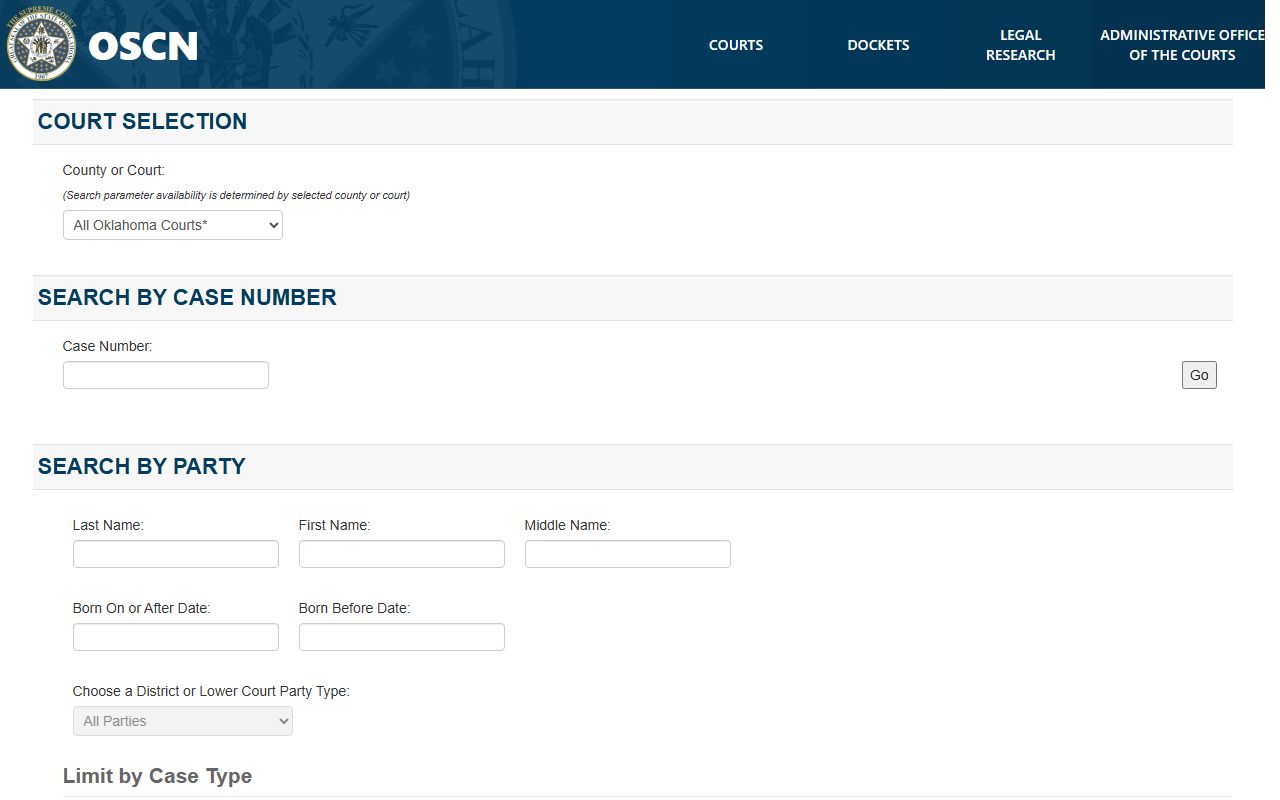
The two main public court search channels are OSCN Docket Search and On Demand Court Records. OSCN lets a user select Osage County District Court and search by case number, party, filing dates, closed dates, case type, lower-court number, and traffic citation. ODCR includes Osage as a court option and offers court group, court, party name, party type, case type, and full case number fields. Some ODCR features may require JavaScript, login, payment, or a separate transaction.
- Search the jail roster first if current custody is the concern. It can provide name spelling, booking date, and a charge clue.
- Open OSCN and choose Osage County District Court, then search by defendant last name and first name.
- Add date limits or criminal case types if there are too many matches. Common prefixes include CF for felony and CM for misdemeanor.
- Open the case and read the filed charge list, docket events, bond entries, warrants, and next settings.
- Search ODCR if OSCN is incomplete or hard to navigate, then contact the Court Clerk for certified copies or older files.
The OSCN screenshot in the manifest comes from the Oklahoma State Courts Network docket search page.
Osage County Court Search Fields
OSCN has more structured fields than the jail roster. A court-records-after-arrest search can start with a name, but case type and date fields are useful when the defendant has a common name or several older cases. The party type field can narrow results to defendants, bondsmen, prosecutors, probation, or other parties, although most users looking for a criminal case begin with the defendant name.
| Field Label | Type | Required | Options / Format Notes |
|---|---|---|---|
| County or Court | Dropdown | Yes or unspecified | Select Osage County District Court from Oklahoma courts. |
| Case Number | Text | Optional | Use CF, CM, TR, PO, or other case prefix if known. |
| Last Name / First Name / Middle Name | Text | Optional | Use party name fields to search a defendant. |
| Born On or After / Born Before | Date text | Optional | DOB range can narrow common names when available. |
| Party Type | Dropdown | Optional | Includes Defendant, District Attorney, Bondsmen, Department of Corrections, Probation and Parole, and others. |
| Limit by Case Type | Dropdown | Optional | Includes Criminal Felony, Criminal Misdemeanor, Criminal Probable Cause, Traffic, Search Warrant, and Protective Order. |
| Cases Filed or Closed Dates | Date text | Optional | Use filing or closed date ranges when searching after a known arrest date. |
Filed Charges After Jail Arrest
Oklahoma law recognizes prosecution by indictment or information, and local criminal cases commonly move from arrest to a formal filing by the prosecutor. The charging document is the point where the court record takes shape. It should not be read as a conviction. It is the formal accusation or filing used to start or continue the case in court.
| Document | Who Uses It | What It Does |
|---|---|---|
| Complaint | Law enforcement or prosecutor, depending on case stage | States alleged facts or offenses and can support initial court action. |
| Information | District Attorney | Formal prosecutor-filed charge document used in many Oklahoma criminal cases. |
| Indictment | Grand jury process | Formal accusation returned through a grand jury when that process is used. |
District 10 serves Osage and Pawnee counties. The official District Attorneys Council page lists the Osage County office at the courthouse in Pawhuska, and the county DA page describes felony and misdemeanor prosecution, victim advocacy, juvenile and special prosecutions, legal counsel to officials, and law-enforcement coordination. That prosecutor role is why jail charges can change before they become court records after a jail arrest.
Charge Status in Court Records
Osage County court records after a jail arrest can change several times. A charge may be pending at filing, amended after review, reduced through negotiation, dismissed by the court or prosecutor, or resolved by plea, trial, deferred disposition, or another court order. Read the docket entries and minute text with the filed charge table, because the charge line alone may not show the current status.
| Status | What It Means |
|---|---|
| Pending | The charge is active and has not reached a final disposition. |
| Amended | The prosecutor or court record changed the wording, count, level, or cited offense. |
| Reduced | The filed offense was changed to a lower level or lesser offense. |
| Dismissed | The charge was dropped or ended without a conviction on that count. |
| Disposition | The result of the charge, such as plea, conviction, dismissal, acquittal, or deferred outcome. |
Important: A charge is an accusation. A conviction requires a plea, verdict, or other final court outcome.
Bond Entries After Arrest
Bond information may appear in court minutes even when it is not visible on the Osage County jail roster. The official registered bondsmen page says licensed bondsmen must complete bond paperwork correctly, and bonds with missing notarization or case numbers may not be accepted, approved, or filed by the court clerk. The Sheriff's Office warns that paperwork errors can leave a defendant subject to re-arrest. That local warning is important because bond is both a custody issue and a court-record issue.
| Bond Type | How It Works |
|---|---|
| Cash bond | Money paid as the court requires. Confirm payment method with the jail or Court Clerk before arrival. |
| Surety bond | A licensed bondsman posts the bond. Osage County publishes registered bondsmen information and paperwork cautions. |
| Personal recognizance | Release on a promise to appear if ordered by the court. |
| No-bond hold | Payment of a normal bond does not release the person until the court or holding agency changes the hold. |
| Agency hold or detainer | Another county, DOC, ICE, tribal, probation, parole, or federal agency may keep custody active. |
Warrants and Court Records
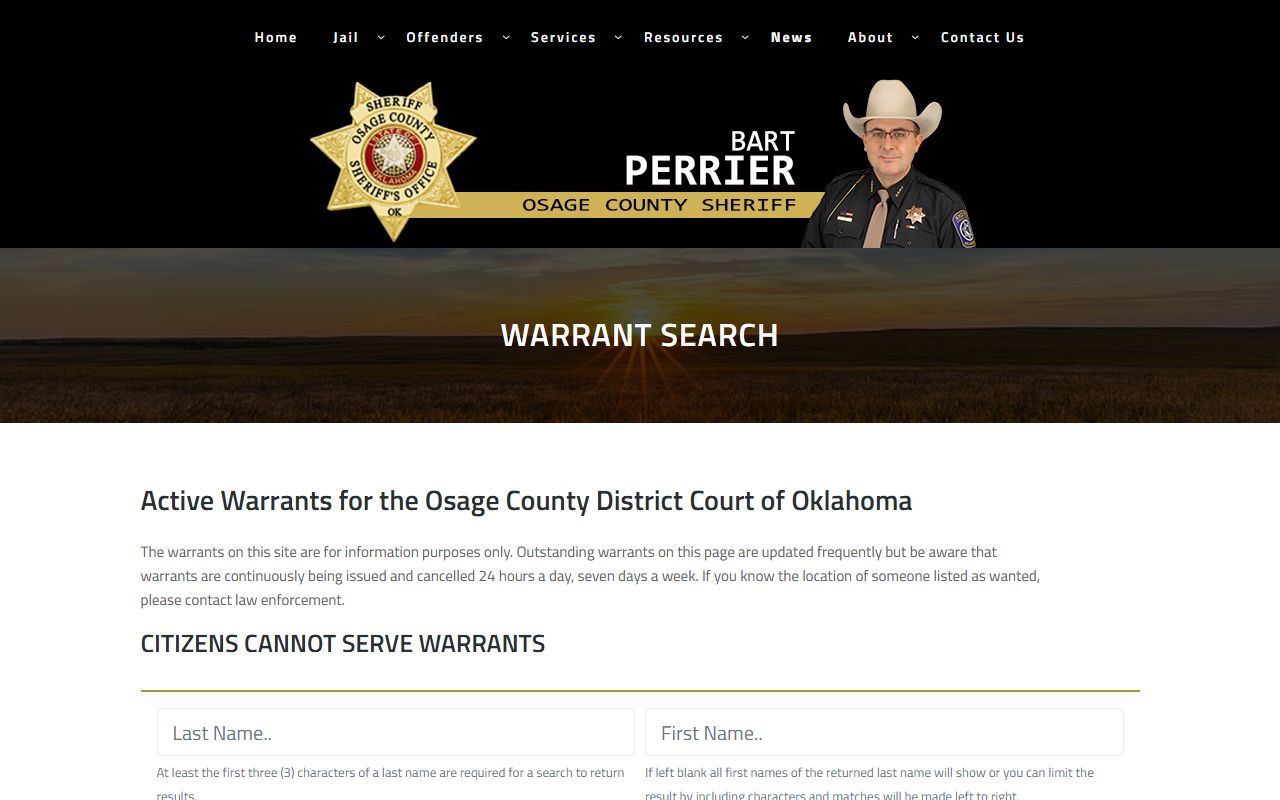
Osage County has an official active warrant search for Osage County District Court warrants. It is informational, updated frequently, and warns that warrants can be issued or cancelled at any time. Citizens cannot serve warrants. People who know they have an outstanding Osage County warrant can surrender at the Sheriff's Office at 900 Saint Paul Ave in Pawhuska at any time.
The warrant search requires at least the first three letters of a last name. A first name can narrow results left to right. The Most Wanted page can add public context, such as photos, dates of birth, warrant numbers, issued dates, bond values, and charge narratives, but it is not a complete court docket. Search OSCN or ODCR for the case behind a warrant.
The warrant-search screenshot in the manifest comes from the official Osage County active warrant search page.
Charges vs Convictions
Public court records after a jail arrest can show accusations before any final result. That distinction matters for employment, housing, licensing, family, and immigration questions. A filed charge means the prosecutor has brought an allegation into court. A conviction means there has been a plea, verdict, or other finding that resolves guilt on that charge. Some charges are dismissed, deferred, amended, or reduced.
| Issue | Charge | Conviction |
|---|---|---|
| Stage | Filed accusation after arrest or investigation. | Final or adjudicated outcome on a count. |
| Proof | Can be based on probable cause and prosecutor review. | Requires plea, verdict, or court finding. |
| Record meaning | Shows what was alleged in court. | Shows what was resolved as guilt or an equivalent outcome. |
| Can change | May be amended, reduced, dismissed, or added to. | May be appealed, modified, expunged, or otherwise affected by later orders. |
Sealed and Expunged Records
Oklahoma expungement law, including 22 O.S. Section 18 and related provisions, can allow eligible people to petition to seal arrest and court records. The research did not locate an Osage County mugshot-removal policy or a court-clerk shortcut that bypasses the legal process. A person seeking relief after dismissal, acquittal, or another eligible disposition should use the court process and then present signed orders to the agencies that maintain the records.
| Issue | Sealed | Expunged |
|---|---|---|
| Public view | Hidden from normal public access when the order applies. | Treated under the expungement order as no longer public in the covered record set. |
| Agency action | Requires agencies to follow the signed order for covered records. | Requires court-directed handling under Oklahoma law for eligible cases. |
| Eligibility | Depends on the case result and statutory conditions. | Depends on Oklahoma expungement law and court approval. |
| Practical step | Get certified court orders before contacting record holders. | Send the signed order to the originating agency if a public jail record remains visible. |
Juvenile matters, sealed records, active investigations, confidential information, and some victim or witness information may be restricted even when other court data is public. Certified copies and official case-file access should be requested through the Osage County Court Clerk, Lavendar Carroll, at 600 Grandview, Room 304, Pawhuska, OK 74056, during the office's published weekday hours.